Who Stole the Colour From My Black T-Shirt?
Let me tell you about a black T-shirt.
It was black. Not "kind of dark grey" black. Proper, deep, swallow-the-light black. The kind of black that makes any outfit look like you planned it. I bought it, wore it on a Saturday, and felt like the main character.
Quick answer: Black clothes fade mainly because of sunlight. UV rays break the dye molecules that absorb light, and oxygen, heat and moisture speed up the damage. Drying clothes inside out, in the shade, and washing them in cold water keeps black clothes black much longer.
But that answer skips the best part. Here's how I found out.
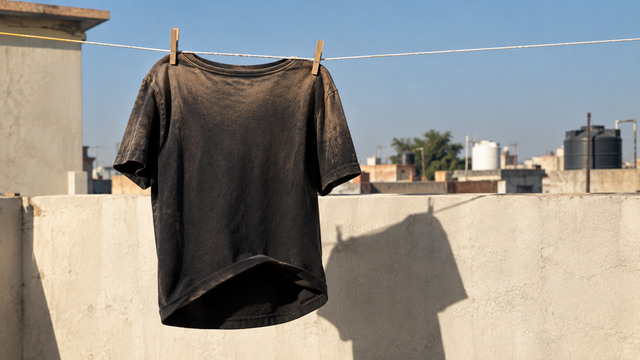
After that first Saturday, I did what every one of us in India does. I washed the shirt, took it up to the terrace, and pinned it on the clothesline in the afternoon sun. It dried in an hour. Easy. Repeat that every week.
Three months later, I pulled it out of the cupboard and stopped.
Something was wrong. My black T-shirt had faded. It wasn't black anymore. It was a tired, dusty, brownish-grey. The kind of colour that looks like it has seen things. And here's the part that made the hair on my neck stand up: the back of the shirt was more faded than the front. The shoulders were the worst. The inside of the shirt? Still almost perfectly black.
Someone had stolen the colour from my shirt. And they had done it slowly, quietly, week after week, right in front of me.
This is the story of how I found out who did it.
What Makes Clothes Fade? Detergent, Washing Machine or the Sun
Every good mystery starts with a line-up. So I made one.
Suspect 1: The detergent. Strong, foamy, smells like "ocean breeze." Detergents can definitely pull some dye out of fabric. But if it was the detergent, why would the inside of the shirt still be dark? The detergent touched every part of it equally.
Suspect 2: The washing machine. All that spinning and rubbing wears fabric down. Fair. But the machine doesn't care which side of the shirt is facing out.
Suspect 3: Hard water. Minerals in water can make clothes look dull. Possible. But dull is not the same as fading in a pattern.
Suspect 4: The sun. It was just... there. Every week. Shining on the terrace like it always does. Doing nothing suspicious. Or so it seemed.
Here's the thing about a pattern. The back and shoulders faded the most. And which parts of a shirt face the sky when it's hanging on a clothesline? The back and the shoulders.
The inside of the shirt never saw daylight. And the inside was fine.
The sun had been at the scene of the crime every single time. But how does the sun fade clothes? Light doesn't have hands. It doesn't scrub. It doesn't soak. How do you steal colour by just shining on something?
To answer that, I had to figure out what colour actually is. And that's where it gets weird.
How Fabric Dye Gets Its Colour (Clue #1: Colour Is a Lie)
Here's something nobody tells you in school in a way that actually sticks: your T-shirt doesn't "have" a colour the way it has a size.
Sunlight looks white, but it's actually every colour mixed together. Red, orange, yellow, green, blue, violet, all travelling as one beam. When that light hits your shirt, the shirt eats some of those colours and throws the rest back at your eyes. Whatever bounces back is the colour you see.
A red shirt swallows most of the light except red. Red bounces off, hits your eye, and your brain goes, "Ah, red." A black shirt is the hungriest of all. It swallows almost everything, so almost nothing comes back. That's what black is: the absence of returned light.
So what's doing the swallowing? Not the cotton. Plain cotton is basically off-white. The swallowing is done by fabric dye.
Zoom in far enough, way past what any microscope in your school lab could show, and a dye is just a molecule. A tiny structure of atoms holding hands. Inside that structure is a special section that chemists call a chromophore, which roughly means "colour carrier."
The chromophore is usually a chain of atoms linked by alternating single and double bonds, like a zip running along the molecule. That pattern lets the molecule grab specific colours of light and hold onto that energy. The exact length and shape of this "zip" decides which colours it eats and which it rejects.
Remember that word. Chromophore. Because if you break it, even a little, the molecule stops eating light. And when the dye stops eating light, the colour is gone.
The molecule is still sitting there in your shirt. It just doesn't do anything anymore. It's like a lock with the inside smashed. Looks like a lock from outside. Doesn't work.
So the question changed. It wasn't "who washed the colour away?" anymore.
It was: who broke the locks?
Does the Sun Fade Clothes? How UV Rays Break Dye (Clue #2)
Sunlight is not one thing. It's a whole gang.
There's the visible light, the colours we just talked about. There's infrared, which you feel as warmth on your skin. And then there's the one that hides in plain sight: ultraviolet light, or UV.
You can't see UV. Your eyes simply aren't built for it. But you've definitely met it. It's the reason you get a tan. It's the reason you get sunburnt. It's the reason your dermatologist won't shut up about sunscreen.
Here's what makes UV dangerous. Light travels in tiny packets of energy called photons. Different colours of light carry different amounts of energy per packet. Red light packets are gentle. Blue light packets hit harder. And UV packets? UV packets hit like a cricket ball.
A single UV photon carries enough energy to snap a chemical bond. Not bend it. Snap it.
Now think back to our dye molecule, with its delicate colour-carrying zip of atoms. Every second your shirt hangs in the afternoon sun, it's being hit by an unimaginable number of UV photons. Most of the time, the dye absorbs the energy and calms back down, no harm done. But every now and then, one hit is too much. A bond breaks. The zip splits. That one dye molecule goes blank.
One molecule losing its colour means nothing. Your shirt has trillions of them.
But repeat that every week. For hours at a time. For months. Slowly, the number of working dye molecules drops. And slowly, your black turns grey, then brown, then that sad colour you can't even name. This is UV fading, and it's why clothes fade in the sun even when you can't see it happening.
There was no single moment when the shirt changed. It was a crime committed one molecule at a time.
But the sun wasn't working alone.
Why Heat, Oxygen and Wet Fabric Make Fading Worse (Clue #3)
Every great villain has a crew. The sun's crew was hiding in the air the whole time.
Accomplice 1: Oxygen. The same oxygen you're breathing right now. When sunlight pumps energy into a dye molecule, that molecule gets "excited" (yes, that's the actual scientific word). An excited molecule can pass its extra energy to nearby oxygen, turning it into an extremely reactive form. Chemists call these reactive oxygen species, and they behave like tiny vandals. They attack the nearest bonds they can find, which is usually the dye that just energised them.
So the sun doesn't even need to break every bond itself. It lights the match, and oxygen burns the house down. This process has a name: photo-oxidation. Light plus oxygen equals damage.
Accomplice 2: Heat. Chemical reactions speed up when things are hot. A shirt baking on a terrace in an Indian May isn't just getting light, it's getting cooked. Hotter fabric means faster damage.
Accomplice 3: Moisture. Remember when I said the shirt dried in an hour? That first hour, while it's still wet, is when the gang does some of its best work. Water helps the reactive chemicals move around and reach the dye more easily. Wet fabric in harsh sun is a crime scene with the doors left open.
Here's the full picture of what was happening every week on my terrace:
- Wet shirt goes up in hot sun.
- UV and visible light pump energy into the dye molecules.
- Some bonds snap directly.
- Others get finished off by reactive oxygen.
- Heat and moisture speed the whole thing up.
- A few more molecules go blank. Repeat next week.
Case closed?
Not quite. Because I noticed something else that didn't fit.
Why Black Clothes Turn Brown or Purple When They Fade
My black shirt was ruined. But my old white polyester gym tee, dried on the same line for years, looked basically the same. And a navy cotton shirt had faded too, but differently. It had gone slightly purple-ish.
Why would the same sun treat different clothes differently?
Not all dyes are built equally tough. The fashion industry actually measures this. It's called lightfastness: how well a colour survives light. Labs test fabric under special lamps that copy sunlight, then compare how much it faded against a set of reference blue wool samples, rated from 1 (fades fast) to 8 (barely budges).
A few things decide where your clothes land on that scale:
- The dye's chemistry. Some colour-carrying structures are just more fragile. Bright reds, pinks and some blues are often more delicate than earthy shades.
- The fabric. Cotton and polyester take different kinds of dye. Polyester is usually coloured with dyes locked inside the fibre, which tends to hold up better in sun. Cotton dyes sit in a more exposed spot.
- Black is often a mix. Many black dyes are combinations of other colours. If one of those colours breaks faster than the others, the leftovers show through. That's why black clothes turn brown, reddish or purplish when they fade instead of just grey. My navy going purple? Same story.
And here's the plot twist inside the plot twist: the sun doesn't stop at the dye.
UV also attacks the fibres themselves. Cotton is made of long chains of cellulose. Polyester is made of long chains of plastic polymer. UV snaps those chains too. That's why old curtains get thin and rip easily on the side facing the window. That's why a flag that's flown for a year starts fraying at the edges.
So my shirt hadn't just lost its colour. It had lost a bit of its strength too. The sun was taking both.
The Twist: Sun Bleaching Used to Be a Job
By now I was ready to file a complaint against the sun. Then I found out something that flipped the whole story.
For hundreds of years, people wanted this to happen.
Before chemical bleach existed, raw linen and cotton came out a dull, yellowish-brown. To make it white, people in places like Ireland, Scotland and the Netherlands laid long sheets of cloth out on grass fields, sometimes for weeks. They kept it damp and let the sun do its thing. These were called bleaching greens or bleach fields, and whole villages worked on them.
Sun, moisture, oxygen. The exact same gang that ruined my T-shirt was, for centuries, a paid professional.
And it's not just history. Grandmothers across India still put white clothes out in strong sun to "brighten" them. Some denim lovers deliberately hang their jeans in the sun to speed up fading and get that worn-in, vintage look.
So the sun was never evil. It doesn't care whether you want your fabric lighter or not. It just does chemistry, every day, to everything it touches.
The real question isn't "how do we stop the sun?" It's "how do we stop handing it our favourite clothes?"
How to Wash Black Clothes So They Don't Fade
The sun is the main thief, but the washing machine weakens the dye first. Weakened dye fades even faster in sunlight. So protecting black clothes starts in the wash:
- Wash black clothes separately. Lighter fabrics cause friction and lint, which makes black look dull and fuzzy.
- Turn them inside out. The inside takes the rubbing, so the outside stays dark. It also protects prints and graphics.
- Use cold water. Hot water loosens dye. Cold water cleans just as well for everyday wear.
- Pick a mild liquid detergent. Harsh detergents and powders can strip dye and leave white streaks on dark fabric.
- Use a gentle or short cycle. Less spinning means less wear.
- Don't overload the machine. Clothes need room to move, or they rub each other dull.
How to Prevent Black Clothes From Fading in the Sun: 7 Tips
Now that we know exactly how the crime works, stopping it is simple. You're cutting off the gang's access.
- Turn clothes inside out before drying. Remember how the inside of my shirt stayed black? Let the inside take the hits instead.
- Dry in the shade, not in direct sun. A shaded balcony, under a shed, or indoors with a fan. Air dries clothes. You don't need the sun's full blast.
- Take them down once they're dry. Clothes left on the line for an extra five hours are just getting free damage.
- Avoid the harshest hours. If the terrace is your only option, early morning or late afternoon light is much gentler than noon, especially in an Indian summer.
- Wash cold and use a mild detergent. Hot water and harsh soap loosen dye, and weakened dye fades faster in sunlight.
- Don't over-wash. Not every wear needs a full wash. Fewer washes mean fewer trips to the terrace.
- Store away from windows. Even sunlight through glass slowly fades clothes left on a chair or a rack near the window.
In monsoon, it's tempting to throw clothes out the moment the sun appears. That's exactly when wet fabric meets strong UV. Dry them indoors under a fan instead.
How to Make Black Clothes Black Again
Once a dye molecule's colour carrier is broken, it doesn't come back. No wash or hack repairs it. But a faded black T-shirt isn't always finished.
- Re-dye it. A black fabric dye from a craft or hardware store adds fresh dye molecules on top of the broken ones. Cotton takes it well. Polyester usually needs a dye made for synthetics.
- Check for fuzz first. Sometimes a shirt looks faded because the fibres on the surface are roughed up and catch light. Removing that fuzz with a lint roller or fabric shaver brings back some depth.
- Know when to let go. If the fabric has gone thin at the shoulders, UV has damaged the fibres too. Dye will fix the colour, not the strength.
The better move is protecting the next black tee from day one.
Case Closed: Who Stole the Colour?
So, who stole the colour from my black T-shirt?
It was the sun, with UV light as the weapon, oxygen as the partner, and heat and moisture holding the door open. The motive? There wasn't one. It was just physics and chemistry, happening the same way it has for thousands of years.
The twist is that I was the one who kept inviting the thief over. Every single week. Hanging my favourite shirt in the brightest spot on the terrace and wondering why it looked tired.
Every YOUR20S tee comes with a care label for exactly this reason. Wash cold, dry inside out in the shade, and your black stays black. Shop the collection.
Frequently Asked Questions
Does the sun fade black clothes? Yes. UV rays break the bonds in dye molecules, so black fabric left in direct sun slowly turns grey or brown.
Why do black clothes fade faster than other colours? Black needs a lot of dye, so any loss shows clearly. Black also absorbs more light and heat when it's drying in the sun.
Why do black clothes turn brown when they fade? Most black dyes are a mix of several colours. When one breaks down faster, the leftovers show through as brown or purple.
Is it better to dry black clothes inside or outside? Shade or indoors. If you must use direct sun, turn them inside out and take them down as soon as they're dry.
Does polyester fade less than cotton? Usually yes. Polyester dyes sit locked inside the fibre, while cotton dyes are more exposed.
Can you restore a faded black T-shirt? Partly, with a black fabric dye. Broken dye doesn't come back on its own.
Does washing in cold water stop fading? It slows it a lot. Hot water loosens dye, which then fades faster in the sun.
Join the Conversation
"Join the silence. Sign in to add your perspective."
Sign In to DiscussNo perspectives shared yet. Be the first.
