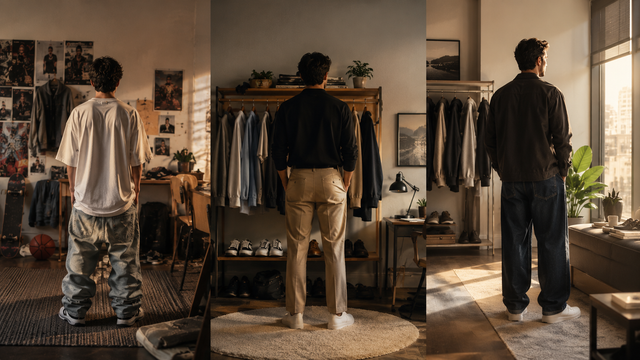
Your Clothes Grow With You: From College Fits to Adult Style
You know that feeling when a song comes on — one you haven't heard in years — and suddenly you're not in your car anymore? You're back in your hostel room, getting ready for a night out, spraying too much deodorant, arguing with your roommate about whose turn it is to iron the one good shirt you both shared. The music didn't change. You changed. But for three minutes and forty seconds, you're seventeen again.
Fashion does the exact same thing. Except nobody talks about it like that.
We treat clothes like they're just fabric and stitching, like they're practical decisions we make every morning without thinking. But be honest with yourself for a second. You remember outfits. You remember what you wore on your first day of college. You remember that one jacket that made you feel untouchable. You remember the shoes you saved up for and the jeans you destroyed and the hoodie you still haven't thrown away even though it has a hole the size of your fist in the sleeve.
Your wardrobe isn't just a closet. It's a timeline. And if you look closely enough, it tells the whole story of who you've been.
The Teenage Uniform
Let's start where it all began. Your teenage years. The era of zero self-awareness and maximum confidence. Remember the oversized tees that your mom said made you look homeless? The baggy jeans that pooled around your ankles like you were melting into the floor? The sneakers that weighed more than your school bag? You wore all of it like armour. That wasn't fashion to you — that was identity.
You didn't pick those clothes because a magazine told you to. You picked them because your friends wore them, because your favourite rapper wore them, because some kid in school walked in one day looking impossibly cool and you thought — yeah, that's who I want to be. The clothes weren't the point. The belonging was. And for a few years, that was enough.
The Great Overcorrection
Then something happened. College. Or your first internship. Or that one family wedding where an aunt looked at you and said something that stuck. Whatever the trigger, you decided it was time to grow up. And growing up, apparently, meant killing everything you used to wear.
Out went the baggy. In came the slim fit. Out went the loud graphics. In came the safe solids. You learned words like "minimal" and "clean" and "versatile" and built an entire wardrobe around not standing out. You wanted to be taken seriously, and somewhere along the way you decided that meant being forgettable.
And honestly? It worked for a while. The structured shirts, the fitted trousers, the sensible shoes — they got you through interviews, first jobs, dinners where you needed to look like someone who paid their own rent. You looked put together. You looked responsible. But if you're being really honest, you also looked like everyone else. You traded personality for polish, and some part of you felt that trade every single morning.
The Full Circle Nobody Expected
Now here's where this gets interesting. Scroll through any feed right now. Walk through any store. Look at what the world is wearing in 2026. Oversized tees. Baggy jeans. Chunky sneakers. Wide legs. Boxy fits. Relaxed everything.
Does that sound familiar? It should. Because fashion just did something absolutely wild — it gave you permission to dress like your teenage self again.
The same silhouettes your mom roasted you for are now sitting on premium racks with designer labels. The same aesthetic you abandoned in the name of "adulting" is now the aesthetic. The trends didn't just come back. They came back validated.
But here's the part that will mess with your head — you're not the same person who wore them the first time. And that changes everything. When you were sixteen and threw on an oversized tee, it was accidental. You didn't know what you were doing. You were just vibing. Now, at twenty-seven or thirty, when you reach for that same shape, you're making a choice. You know what fits your body, you know what colours work on your skin tone, you know the difference between looking effortless and looking like you gave up. The outfit might be the same. The intention behind it is a different universe.
That's the full circle nobody warned you about. The style comes back, but you come back to it as a completely different person.
Why This Hits Different
This is why fashion nostalgia is more than just trends recycling. It's personal. When you see baggy jeans trending again, you're not just seeing a silhouette — you're seeing your teenage self in a dressing room, you're seeing your college self rejecting them, and you're seeing your adult self picking them back up with a quiet nod that says I understand now.
It's the same reason you can't throw away that old hoodie. It doesn't fit your body anymore, maybe it doesn't even fit your style anymore, but it fits your story. And your story is the one thing no trend cycle can replicate.
So here's what I want you to sit with. We spend so much time debating what's "in" and what's "out," what's trendy and what's dated, that we forget the most important question — does it feel like you?
Not you at sixteen, trying to fit in. Not you at twenty-two, trying to look grown. You, right now, with all of those versions still living somewhere inside your closet and your memory.
Because the best-dressed people you know aren't the ones following every trend. They're the ones who figured out which parts of their past to keep and which parts to let go. They took the confidence of their teenage self, the polish of their adult self, and made something that doesn't need a label or a trend cycle to make sense.
Your clothes were never just clothes. They were chapters. And the beautiful part is — you get to decide which ones stay in the story.
So tell me — what are you reaching for tomorrow morning? And more importantly, why?
Join the Conversation
"Join the silence. Sign in to add your perspective."
Sign In to DiscussNo perspectives shared yet. Be the first.


